
The first question we get asked about this trip is, “What exactly is the Great Loop and where will you be going?”
The Great Loop Explained
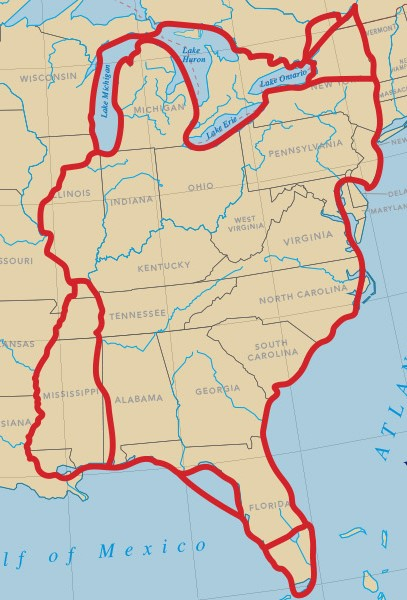
Like a lot of you, we had never heard of the Great Loop until a few years ago. Once we began the research, we realized there are “Loops” in many places around the world. For boaters, these are all places where we can travel by boat continuously and return to the same spot. America’s Great Loop is a 6,000-mile circumnavigation of the eastern half of the United States by water.
Which Route Have We Chosen?
We are planning to do the all-USA route the first time around. You will see from the map above (thanks for this graphic AGLCA), that the first section of the Loop when beginning from Florida is the same for most Loopers. We travel with the seasons and will spend spring going north along the ICW (Intracoastal Waterway). The ICW offers a protected (and within sight of land) route between Florida and New Jersey. The only portion of the Loop in the Atlantic Ocean is the short route between Cape May, NJ and New York Harbor where most Loopers take a bucket list opportunity to get a picture on their boat in front of the Statue of Liberty.
The second section will begin from NYC and take us north along the Hudson River. If you look at the map above, this is where we have many choices for our route. We plan to take the entire Erie Canal all the way from Albany, NY to Buffalo, NY. We will then head west along the southern shore of Lake Erie and eventually find ourselves heading north through Detroit and into Lake Huron. The Great Lakes will be especially exciting because we have a lot of family and friends to visit. We will spend as much time here as possible and if we aren’t in Chicago by close to Labor Day, we will leave ALIGARO “on the hard” and return for her in the spring of 2027.
Will We Complete the Great Loop in One Year?
There is a chance that we will just continue and finish the Loop in the fall taking the inland Rivers (Illinois, Ohio, Mississippi and the Tombigbee Waterway) all the way to Mobile, AL. This would put us back in Florida by the end of November 2026 or November 2027 if we leave the boat in Michigan for the winter. Decisions, decisions.
Once we are on the Gulf Coast of Florida, there are a couple of routes to choose from to “cross our wake” in Jupiter. We can go all the way around the bottom of Florida and to Key West or we can cut across at Ft. Myers and go through the Okeechobee Waterway. We haven’t decided between them yet but will keep you posted when we do.
Where will we be and when?
This is something we get asked a lot and in all honesty my planning soul would love to know. However, one of the consistent pieces of advice we get is NOT to have a timeline and to do the Loop according to our own style. Because we are new to this, we don’t have an exact style worked out yet, but we have some ideas.
Our Personal Cruising Parameters
We plan to travel on weekdays and avoid the weekend traffic. We will leave early on travel days and plan to typically cover 30-40 nautical miles. This allows for lots of stops to explore and makes planning travel days easier because of the weather and only needing a 3–4-hour window for cruising each day. Speaking of weather, this is the most important variable on the Great Loop. We are both very safety conscious and don’t like to be uncomfortable if we can help it. There’s a saying, “the boat can take a lot more than the humans on board.”
This brings us to our crew. We have a set of “go” or “no go” parameters which work for us. We are fortunate to be comfortable on the water, but we are also traveling with our dog. Oslo is a good traveler in a car or an RV. We will see how he does on the water and get back to you. For now, we will only be traveling if the winds are under 10 mph and the seas are less than 2 feet for our entire travel window. Having these basic parameters takes the pressure and guess work out if we are traveling on any giving day. It’s also a rule on our boat that a “no go” outweighs a “go” if we have two different opinions. Safety will always be first.